
August 18, 2025
Arthur C. Clarke, the great science fiction writer, once observed that cave dwellers froze to death on beds of coal—lying on the very resource that could have saved their lives. But they had no way to find the coal, mine it, or use it. Today, several millennia later, a similar phenomenon is happening again
—this time, in education.
—Peter Lui
Our K–12 education system is often resting on outdated philosophies of so-called “best practices.” One such area is benchmarking in education. While benchmarking can drive transformation, improve school performance, and enhance skills for success, it can easily fail if not done correctly. For benchmarking to be a true best practice, it must be implemented strategically and contextually.
This article explores the common mistakes educators make in benchmarking and provides insights—drawing on NEP 2020, National Professional Standards for Teachers, and Zamit’s educational resources—on how to avoid these pitfalls.
One big pitfall is setting goals that are too ambitious without a clear plan. Benchmarking should align with future readiness and adaptive learning, but expecting instant mastery of 21st-century skills can overwhelm your team. Garcia (2021) in the Journal of Educational Research found that schools with realistic, phased goals saw a 15% higher improvement in student development, a principle echoed in NEP 2020’s focus on gradual competency building.
Comparing your school to a top performer without considering context can lead to frustration. Every school has unique needs, and Future Skills for Students, emphasises tailoring benchmarks to your environment for educational transformation. Miller and Chen (2022) in Educational Policy Review note that ignoring local factors like resources aligns with National Professional Standards, which stress context-aware teaching, affecting career readiness.
Teachers are key to skills for success, yet they’re often sidelined in benchmarking. Engaging them with relevant CPDs and fostering adaptive learning aligns with National Professional Standards’ that emphasis on teacher agency. A Zamit.one blog highlights how teacher collaboration boosts 21st-century skills development, while Thompson (2023) in Teacher Education Quarterly shows a 20% better outcome with active participation.
Relying only on test scores misses the holistic view. Holistic education assessment requires qualitative insights, like engagement, to support career readiness, as advocated by NEP 2020. The Future Skills for Students stresses balancing metrics, and Lee (2020) in Assessment in Education notes a 10% drop in skills for success perception with overemphasis on numbers.
Benchmarking is a cycle of adaptive learning, not a one-time event. Failing to review progress regularly stalls educational transformation and future readiness, contrary to NEP 2020’s call for ongoing assessment. Patel and Singh (2021) in Journal of School Improvement found an 18% improvement with frequent checks.
Jumping into benchmarking without resources like training can hinder skills for success. This aligns with National Professional Standards’ focus on teacher support, and educators recommend tools like the Zamit Quotient (ZQ). Brown (2022) in Educational Technology Journal highlights a 25% lower success rate in career readiness with under-resourcing.
Not keeping parents and students informed creates resistance. Educational transformation relies on transparency, a principle in NEP 2020’s community engagement goals. Furthermore, Kumar (2023) in Educational Leadership Review reports a 30% increase in trust with strong communication.
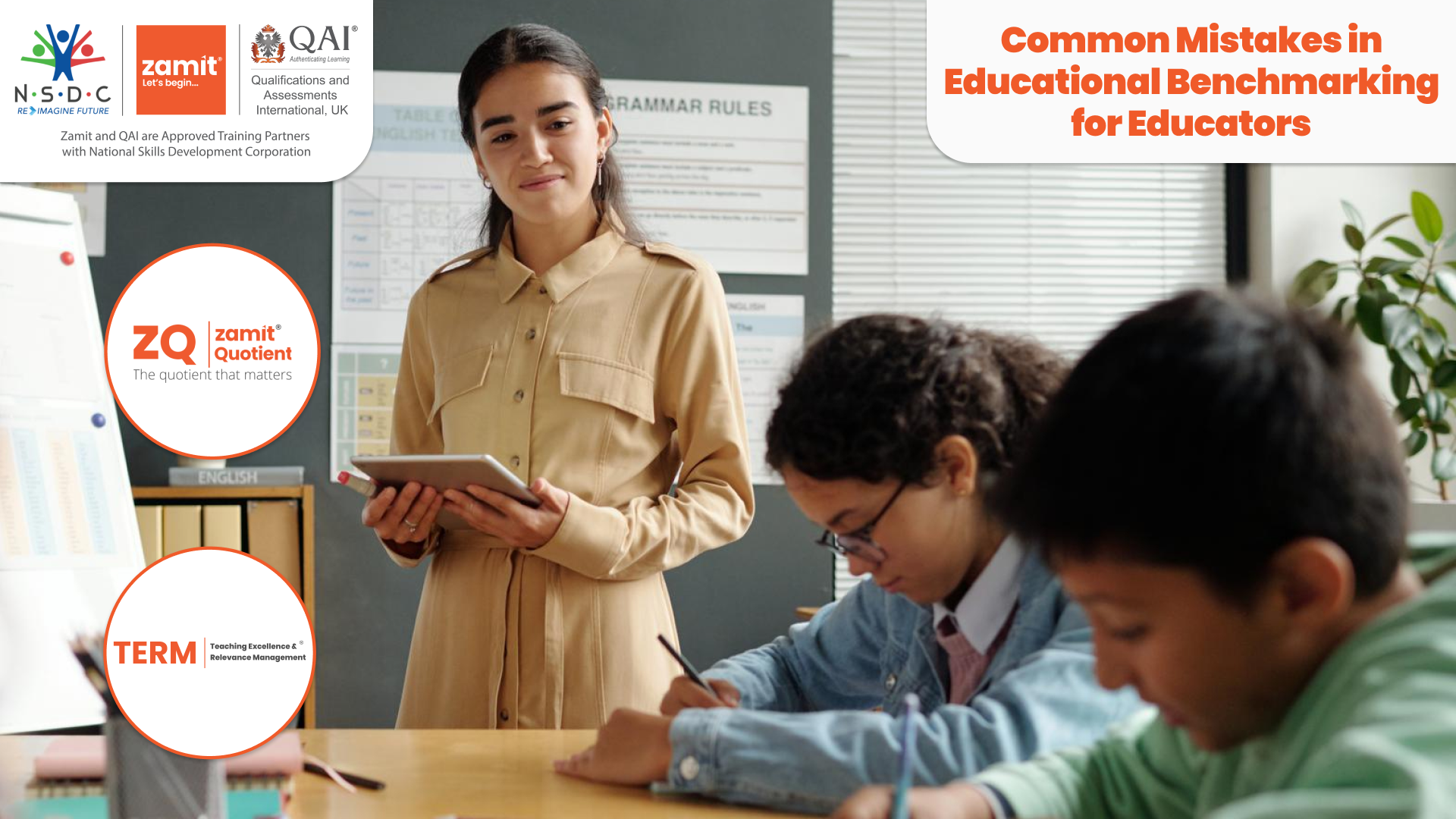
Avoiding these pitfalls turns benchmarking into a tool for future readiness. Reflect on past efforts—where did you slip? Zamit offer certified benchmarking tools, like using ZQ for students and TERM for teachers, aligning with NEP 2020 for a collaborative approach. Communicate with stakeholders to keep everyone engaged in student development.
Ready to refine your benchmarking? Start with a small goal and visit Zamit! Your students’ future readiness depends on it—let’s do this together!
1. What is the biggest mistake in educational benchmarking?
Setting unrealistic goals without a clear plan can hinder progress, as highlighted in NEP 2020.
2. How can I involve teachers in benchmarking?
Engage them using tools like TERM and professional standards frameworks to strengthen teacher agency.
3. Why is context important in benchmarking?
Ignoring context leads to ineffective outcomes and undermines career readiness.
4. How often should benchmarking progress be reviewed?
Ideally, benchmarking should be reviewed quarterly to ensure progress is on track.