February 26, 2026
Beyond Exams: Classroom Strategies and Modern Assessment
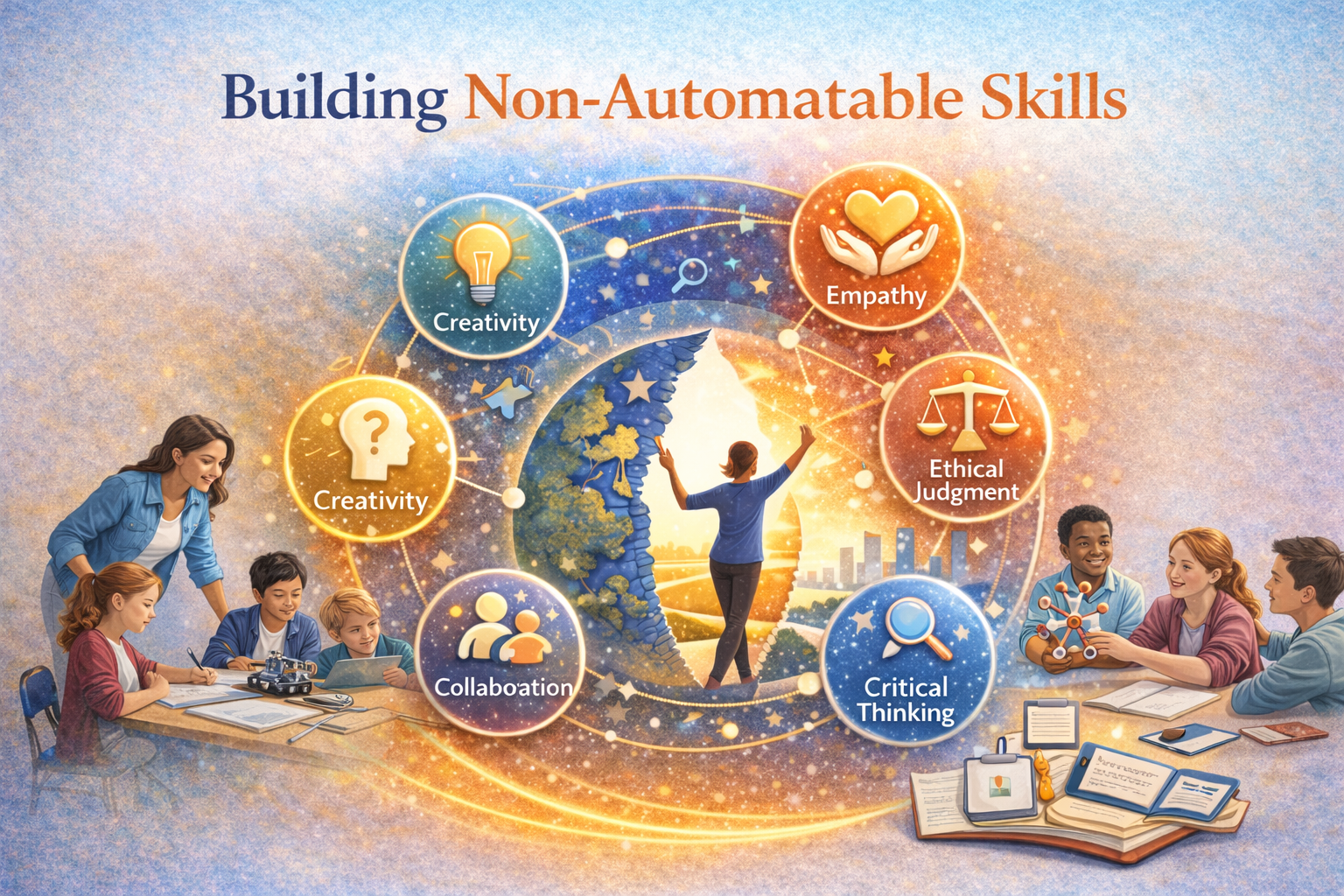
Non-automatable skills—such as critical thinking, creativity, collaboration, empathy, and ethical judgement—develop best through how learning happens, not just what is taught. Teachers can foster these skills by encouraging open-ended questioning, classroom discussions, debates, peer teaching, and real-world problem scenarios linked to subject content.
Small shifts like asking,
“Why do you think this works?”
“What would you do differently?”
“Can there be more than one solution?”
help students move beyond rote answers to deeper thinking, and encouraging students in Grade 9 and beyond to explore available Internships. Group work with defined roles also builds communication and teamwork—skills that machines cannot replace.
Assessment Ideas Beyond Exams
Exams test recall; future skills require application and reflection. Teachers can complement traditional tests with projects, portfolios, presentations, journals, and self-reflections—without adding extra burden. Short research tasks, concept maps, case studies, model-making, or real-life problem solutions allow students to demonstrate understanding in diverse ways. Learning portfolios, where students collect their best work and reflect on progress, help build metacognition and ownership. Even brief reflection prompts such as “What challenged you?” or “What would you improve next time?” strengthen learning and self-awareness.
Integrating Future Skills Without Changing the Syllabus
Future skills can be embedded within the existing syllabus, not added as extra content. The same lesson can build multiple capabilities depending on the approach. For example, a history chapter can include source analysis and debate, a science experiment can emphasise hypothesis-building and teamwork, and a language lesson can focus on communication and perspective-taking.
Project-based tasks, inquiry questions, and real-world examples aligned to textbook topics allow teachers to meet curriculum objectives while preparing students for future work realities. The key shift is from coverage to capability building—using the syllabus as a tool, not a limitation.