
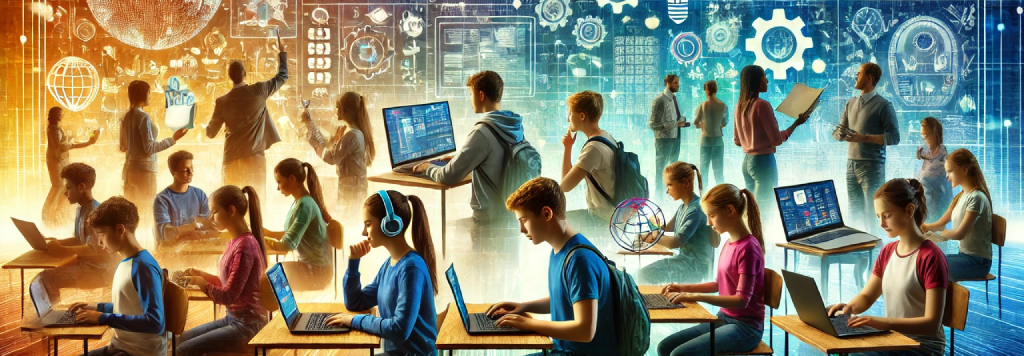
Futuristic-themed illustration of diverse students engaging in activities that represent future-ready skills, including coding on laptops, collaborating on projects, exploring virtual reality, and creating art. The background features a blend of classroom and digital elements with holographic screens and glowing tech interfaces, symbolizing innovation, adaptability, and global connections.dxc

Top Skills Every Future-Ready Student Needs

Top Skills Every Future-Ready Student Needs The world is changing faster than ever and being “future-ready” has become a necessity for students. To succeed in careers and challenges that don’t yet exist, students need a mix of skills that go beyond academics. These future skills for students combine technical know-how, emotional intelligence, adaptability, and creativity. Here’s a look at the top skills students need to thrive and how they can develop them.  Critical Thinking and Problem-Solving  In today’s information-packed world, critical thinking is essential. Students must learn to evaluate information, separate facts from opinions, and make smart decisions. Problem-solving complements this skill by helping students tackle challenges creatively and effectively.  How to develop it:  These skills prepare students to face uncertainty with confidence and resilience.  Digital Literacy and Tech Savviness  Technology is reshaping how we work and live. Being tech-savvy means more than just knowing how to use apps—it’s about understanding how to leverage technology ethically and responsibly.  How to develop it:  Mastering technology helps students stay competitive and innovative in a digital-first world.  Emotional Intelligence and Empathy  In a world driven by automation, emotional intelligence (EQ) makes a big difference. Skills like empathy, self-awareness, and teamwork help students build strong relationships and lead effectively.  How to develop it:  Students with high EQ thrive in collaborative environments and handle conflicts with ease.  Adaptability and Resilience  Change is constant, and the ability to adapt is a must-have skill. Resilience goes hand-in-hand, helping students recover from setbacks and keep moving forward.  How to develop it:  These traits enable students to stay flexible and prepared for whatever the future holds.  Creativity and Innovation  Creativity fuels progress. Whether it’s designing a product or solving a problem, original ideas will always stand out.  How to develop it:  Fostering creativity prepares students to become innovators and leaders in any field.  Global and Cross-Cultural Competence  The world is interconnected, and understanding different cultures is key to success. Future-ready students should know how to work with people from diverse backgrounds and respect global perspectives.  How to develop it:  These skills not only prepare students for global careers but also help them become compassionate global citizens.  Lifelong Learning Mindset  In a fast-changing world, learning never stops. A lifelong learning mindset ensures students stay relevant and continue growing long after school ends.  How to develop it:  This mindset equips students to adapt and thrive throughout their lives.  Developing Future Skills for Student Success  In our previous blog, we discussed how schools can foster future readiness. How can students actively develop these future-ready skills? It starts with creating a supportive environment for exploration and growth.  Key strategies:  Schools and parents play vital roles in shaping students’ futures by providing opportunities and aligning learning with industry trends.  Ethical Leadership and Social Responsibility  Future leaders must prioritize ethics and social impact. Students should understand how their actions affect others and strive for sustainability, fairness, and justice.  How to develop it:  Students who lead with integrity will make a lasting difference in their communities and the world.  Conclusion  To thrive in the future, students need more than academic success. They must master 21st-century skills like critical thinking, adaptability, emotional intelligence, and lifelong learning.  By developing these future skills for students today, they are not just preparing for success—they’re shaping the future itself. The earlier students begin this journey, the brighter their potential to lead and innovate in an ever-changing world. 
Read More
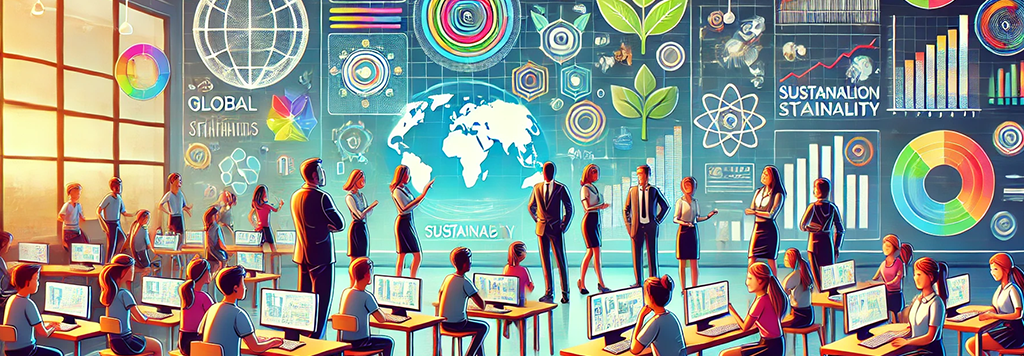
Illustration of a futuristic school environment featuring diverse students and teachers engaging with advanced technology, including interactive screens, robotics, and digital learning tools. The background showcases global education symbols like a world map and sustainability icons, emphasizing innovation, collaboration, and future readiness.dxc

How Schools Can Foster Future Readiness

How Schools Can Foster Future Readiness  The world is changing at an unprecedented pace, and so is the role of education in preparing students to thrive in this ever-evolving landscape. Schools are no longer just institutions for academic learning; they are the breeding grounds for creativity, resilience, and adaptability—qualities essential for navigating the future. The question is: how can schools ensure their students are truly future-ready?  Building on our earlier discussion in Why Future Readiness Matters for Today’s Students, this blog explores actionable strategies schools can adopt to foster future readiness. From integrating Teacher Development Programs to embracing School Readiness Benchmarking and aligning with Global Education Standards, schools have the power to shape a generation of empowered learners ready to tackle tomorrow’s challenges.  Why Future Readiness Matters  The concept of future readiness extends beyond academics. It’s about equipping students with the skills, values, and mindset necessary to thrive in a dynamic world shaped by technological advances, global interconnectedness, and environmental challenges.  For schools, this means reimagining their approach to education—shifting from rote learning to fostering creativity, critical thinking, and lifelong learning. A future-ready school embraces a holistic vision of education, ensuring students are not just prepared for exams but for life.  1. Elevating Teacher Development Programs  Teachers are at the heart of any school’s efforts to prepare students for the future. To truly foster future readiness, schools must invest in robust Teacher Development Programs that equip educators with the tools to teach and inspire in a rapidly changing world.  2. Embracing School Readiness Benchmarking  To foster future readiness, schools need a clear understanding of where they stand and what needs to improve. This is where School Readiness Benchmarking comes in—a framework for assessing how well a school is preparing its students for the future.  3. Aligning with Global Education Standards  In an interconnected world, students need a global perspective to thrive. Aligning with Global Education Standards ensures schools are preparing students to succeed not just locally but internationally.  4. Leveraging Technology for Future Skills  Technology is a game-changer in fostering future readiness. Schools must embrace digital tools to prepare students for a tech-driven world.  5. Building Partnerships with Communities and Industries  The Role of Holistic Education Assessment  A future-ready school uses Holistic Education Assessment to measure not just academic success but also emotional intelligence, creativity, and problem-solving skills. By evaluating students across these domains, schools can ensure they are nurturing well-rounded individuals.  This approach aligns with the principles discussed in Why Future Readiness Matters for Today’s Students—emphasizing the importance of preparing students to excel in life, not just in exams.  Conclusion: The Future Starts Today  Schools have a profound responsibility to prepare students for a world that is constantly changing. By focusing on Teacher Development Programs, embracing School Readiness Benchmarking, and aligning with Global Education Standards, they can create environments that empower students to lead, innovate, and thrive. Future readiness is not just about ticking boxes; it’s about fostering a mindset of growth, adaptability, and resilience. As educators, parents, and communities, we must come together to ensure today’s students are equipped for tomorrow’s challenges. 

Read More
dxc

Vocational Skills vs. Future-Ready Skills – Understanding the Difference

Vocational Skills vs. Future-Ready Skills – Understanding the Difference  In today’s rapidly evolving world, the concepts of “vocational skills” and “future-ready skills” are often used interchangeably. However, while both sets of skills are crucial for success, they serve distinct purposes and are not the same.   This article aims to clarify the difference between these two types of skills and explain why understanding this distinction is vital for effective education and workforce development.  Why Vocational Skills Alone Are Not Enough  Many people believe mastering a specific trade or profession—what we call “vocational skills”—is sufficient to secure future success. While vocational skills are indeed important, they are only one piece of the puzzle. Being “future-ready” requires a broader set of abilities that go beyond the technical expertise of any single job or industry.   Let’s dive deeper into what each of these terms means and how they differ.  What are Vocational Skills?  Vocational skills refer to the specific, practical abilities and knowledge needed to perform tasks and responsibilities within a particular job or industry. These skills are focused, role-specific, and technical, and are designed to prepare individuals for specific roles in the workforce.  Examples of Vocational Skills:  These skills are essential for performing specific jobs effectively. For instance, a carpenter needs to know how to use tools and read blueprints, while a nurse must be skilled in patient-care and medical procedures.  What are Future-Ready Skills?  Future-ready skills, on the other hand, encompass a broader set of competencies, mindsets, and abilities that prepare individuals to adapt to and thrive in an ever-changing world. These skills go beyond technical know-how, focusing instead on adaptability, problem-solving, innovation, and continuous learning.  Examples of Future-Ready Skills:  These skills are not tied to any one profession. Instead, they are essential for navigating the complexities of the modern world, where change is constant, and unpredictability is the norm.  The Relationship Between Vocational and Future-Ready Skills  While there is some overlap between vocational and future-ready skills—particularly in areas like problem-solving and technical proficiency—the key difference lies in their scope and application.   For example, while knowing how to program in Python is a vocational skill, the ability to continuously learn new programming languages and adapt to emerging technologies is a future-ready skill.  Why the Distinction Matters  Understanding the difference between vocational and future-ready skills is crucial for both educators and learners.   Focusing solely on vocational skills might prepare individuals for a specific job, but it may not equip them to handle the broader challenges of a rapidly changing world.   On the other hand, cultivating future-ready skills can ensure that individuals are not only capable of performing their current jobs but are also prepared to adapt to new roles, industries, and opportunities as they arise.  Conclusion  While vocational skills are important, they are not enough on their own. To truly prepare for the future, individuals must also develop a range of future-ready skills that will enable them to thrive in an uncertain and dynamic world.   By understanding and embracing this distinction, we can better equip ourselves and others for the challenges and opportunities of tomorrow. 

Read More