

February 26, 2026
(AR & VR Professional)

When I began my journey in immersive technologies, I assumed that mastering the tools would be the hardest part—learning how to build virtual environments, optimise headsets, or integrate AR into lesson plans.
Years later, I realise that the skills I truly wish I had learnt earlier had far less to do with technology and far more to do with how humans learn, adapt, and collaborate.
First, I wish I had learnt how to learn continuously. In AR and VR, platforms, hardware, and software evolve at breathtaking speed. What you master today may be outdated in two years.
Early in my career, I chased certifications; later, I understood the value of curiosity, experimentation, and self-directed learning. For students today, the ability to learn, unlearn, and relearn will matter more than any single technical skill.
Second, I wish I had developed storytelling and empathy sooner. Immersive technology is not impressive because it is virtual—it is powerful because it can make learners feel present. The most effective AR and VR experiences in schools are built on understanding the learner’s perspective: their age, attention span, fears, and motivations.
Whether you are designing a virtual science lab or a historical reconstruction, empathy and narrative thinking determine whether technology becomes transformative or just flashy.
Third, I underestimated the importance of cross-disciplinary thinking. AR and VR sit at the intersection of education, psychology, design, engineering, and ethics. Early exposure to design thinking, learning sciences, and even philosophy would have helped me create solutions that were pedagogically sound, not just technically impressive.
Schools that encourage students to blend subjects are unknowingly preparing them for future industries like ours.
Finally, I wish I had learnt clear communication and collaboration earlier. Building immersive learning solutions requires educators, developers, school leaders, and students to work together. The ability to explain complex ideas simply—and to listen actively—often matters more than writing perfect code.
If I were a student again, I would worry less about mastering the “right” tool and more about building adaptable, human-centred skills. In a world where technology changes fast, these are the skills that endure.

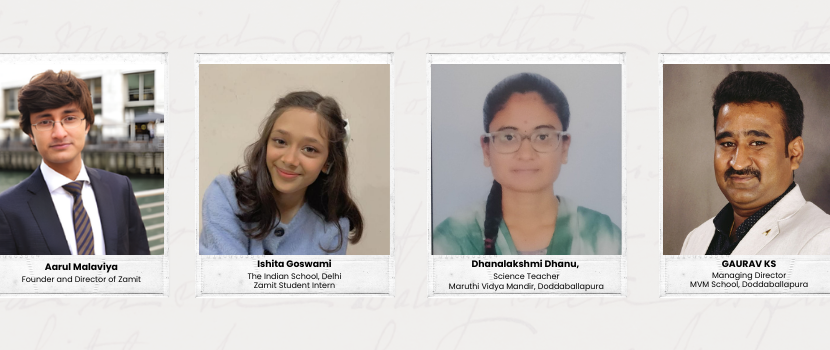
Ishita Goswami
The Indian School, Delhi
Zamit Student Intern
Learning in an AI world feels both exciting and challenging. With AI’s rapid evolution, it’s essential to stay updated on the latest developments and trends. AI is constantly evolving, so learners must adapt quickly to new technologies, tools, and techniques. AI combines concepts from computer science, mathematics, statistics, and domain-specific knowledge, making it a multidisciplinary field. The abundance of online resources, including tutorials, courses, and research papers, makes it easier to learn AI concepts and stay updated on the latest advance Acquiring AI skills can enhance career prospects and open up new opportunities in various industries.
AI can automate repetitive tasks, freeing up time for more strategic and creative work. AI enables learners to develop innovative solutions to complex problems and make data-driven decisions.
The AI field is rapidly evolving, making it essential to stay updated on the latest developments and advancements. AI raises ethical concerns, such as bias, fairness, and transparency, which must be addressed through responsible AI development and deployment.
To navigate this landscape effectively, learners can explore various resources, including online courses, tutorials, and research papers. Some recommended starting points include: Mastering Python programming is essential for AI development and deployment. Understanding machine learning concepts, including supervised and unsupervised learning, is crucial for AI applications.
To conclude, in a world full of technological advancements, the dependence on AI is increasing.
Dhanalakshmi Dhanu
Science Teacher
Maruthi Vidya Mandir, Doddaballapura

As a teacher, I do not just teach the lessons from the textbook; I also witness the hidden struggles of my students every day. Behind their smiles, many of them are dealing with fear, anxiety, self-doubt and distraction.
One incident in my classroom stays with me. While doing the reading activity, when I ask them to read aloud, many students avoid reading loudly; they avoid eye contact and pretend to look somewhere else. Their hesitation is not due to a lack of ability but a lack of confidence and constant comparison with others.
In the same way, many students today find it hard to stay focused for even 10 to 15 minutes without distraction. Even young minds carry the burden of comparison, fear of failure, lack of self-confidence and fear of making mistakes. I often observe the struggle more with emotional and mental challenges than academics.
My students’ struggles show me that they need love, patience and understanding. When teachers speak kindly and support them, the children feel safe to try. Even small acts of support can change students’ lives. A supportive classroom can help them overcome fear and build confidence.

Gaurav KS
Managing Director
MVM School, Doddaballapura
Step into any classroom, and you’ll spot the usual stuff—chewed-up pencils, open notebooks, and that steady buzz from the fluorescent lights overhead. But honestly, the biggest thing in my room today wasn’t the lesson plan. It was this thick, heavy feeling of mental exhaustion.
If you ask a student what threw them off, maybe they’ll mention a tricky math problem or some random date in history they just can’t remember. But from where I stood, the real struggle was quieter and harder to name: just staying focused in a world that seems dead set on pulling your attention in a thousand directions.
People love to call it laziness when a kid stares out the window or can’t keep their eyes on the board. Today, though, it looked more like pure tiredness. My students weren’t losing a battle with the material—they were drowning in distractions. Every few minutes, someone’s phone buzzed. Even when the room was silent, you could feel all that leftover anxiety from the past couple of years just hanging in the air. Sitting still and thinking for twenty minutes? That’s starting to feel impossible.
By the time we hit fourth period, nobody was glazed over because the lesson was boring. They were just worn out. This is what happens to a generation overloaded by nonstop noise, both digital and otherwise. Sure, as teachers, we can keep switching up our methods. But some days, you realise the most important thing we can offer isn’t a new way to teach the content. It’s a little breathing room—a quiet space—where learning actually stands a chance.