
April 30, 2026
Why Schools Must Start Preparing Today
The future of work is not approaching—it is already quietly shaping the classrooms of today.
By 2035, many students currently sitting in school will step into careers that did not exist when their teachers began teaching. The signals are already clear: climate intelligence, immersive technology, ethical AI governance, digital knowledge creation, and youth-led innovation.
For schools, the question is no longer what students should memorise, but what capabilities they must build early.
Forward-looking schools are already rethinking teaching strategies—embedding project learning, interdisciplinary thinking, digital creativity, and real-world problem solving into everyday learning.
Because the careers of 2035 will not simply reward knowledge.
They will reward adaptability, curiosity, and the ability to connect ideas across disciplines.
Here’s a glimpse into the professional lives of tomorrow’s learners.
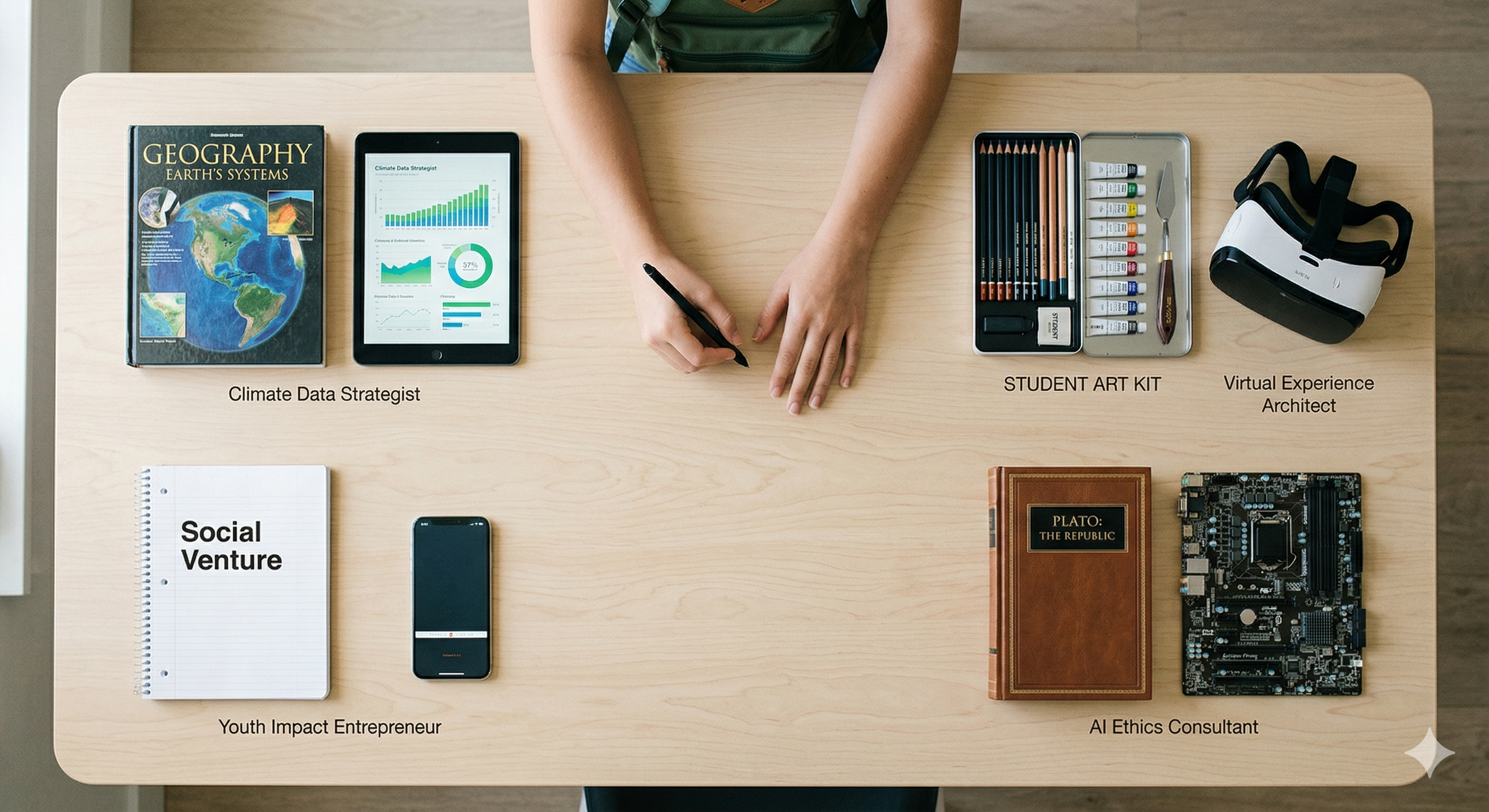
Every lesson taught today quietly shapes the professional journeys of tomorrow. A geography project might spark a future climate analyst. A media assignment could inspire a creator-educator. A classroom debate may lay the foundation for an AI ethics consultant. As the world of work evolves rapidly, teachers play a pivotal role in helping students connect subjects, skills, and mindsets to emerging career pathways. Preparing learners for 2035 means moving beyond content delivery to nurturing curiosity, adaptability, and real-world problem solving.
Here is a road map that will help you to align your students to the future!
What they do: Analyses global environmental data to help governments and companies make climate-smart decisions—predicting floods, planning sustainable cities, and reducing carbon impact.
Skills built in school: Data interpretation, Environmental literacy, Analytical thinking, Digital modelling
Subjects that helped: Geography, Mathematics, Environmental Science, Computer Science
Mindsets that mattered: Curiosity about the planet, systems thinking, and responsibility toward sustainability.
What they do: Designs immersive virtual worlds for education, healthcare simulations, tourism, and training using extended reality (XR) technologies.
Skills built in school: Design thinking, Storytelling, Coding basics, Visual creativity
Subjects that helped: Art & Design, Computer Science, Physics, Media Studies
Mindsets that mattered: Imagination, experimentation, and comfort with emerging technologies.
What they do: Ensures that artificial intelligence systems are fair, transparent, and responsible—guiding organisations on ethical AI use.
Skills built in school: Critical thinking, Debate and reasoning, Understanding algorithms, Ethical decision-making
Subjects that helped: Philosophy / Ethics, Mathematics, Computer Science, Social Sciences
Mindsets that mattered: Integrity, questioning assumptions, and a strong sense of fairness.
What they do: Builds global learning communities through digital platforms—creating educational content, courses, and interactive learning experiences.
Skills built in school: Communication and storytelling, Digital media creation, Audience engagement :
Subjects that helped: Research and knowledge curation, English, Media Studies, Psychology, Technology
Mindsets that mattered: Creativity, confidence in sharing ideas, and entrepreneurial thinking.
What they do
Leads a social venture tackling real-world challenges—from climate innovation to inclusive education and community health.
Skills built in school: Problem-solving, Financial literacy, Leadership and collaboration, Innovation mindset
Subjects that helped: Economics, Business Studies, Social Sciences, Design & Technology
Mindsets that mattered: Purpose, resilience, and the courage to take initiative early.
The Message for Schools:
If these careers define tomorrow, the responsibility begins today. Schools must move beyond content delivery to capability building—encouraging inquiry, interdisciplinary learning, and real-world applications.
The future workforce will not be shaped by exams alone.
It will be shaped by teachers who help students explore, question, create, and solve.
Because the students sitting in classrooms today are not preparing for the jobs of the past. They are preparing for the possibilities of 2035.